If you’re a buy-to-let landlord in the UK — or you’re thinking about becoming one — understanding your tax obligations isn’t optional. It’s essential.
The tax landscape for landlords has changed significantly over the past few years, with major shifts in how mortgage interest relief works, increases in Stamp Duty for second properties, and upcoming changes to rental income tax rates from 2027.
Get it wrong, and you could face penalties, unexpected tax bills, or HMRC enquiries. Get it right, and you’ll know exactly what you owe, when you owe it, and how to legitimately reduce your bill.
This guide covers everything you need to know about landlord tax obligations in the UK — from the moment you buy a property to the day you sell it, and everything in between.
The Three Main Taxes Landlords Pay
As a buy-to-let landlord, you’ll encounter three main types of tax:
- Stamp Duty Land Tax (SDLT) — paid when you buy the property
- Income Tax on rental income — paid annually on your rental profits
- Capital Gains Tax (CGT) — paid when you sell the property (if you make a profit)
You don’t pay them all at once — they apply at different stages of property ownership. Let’s look at each one in detail.
1. Stamp Duty Land Tax: The Upfront Cost of Buying
Stamp Duty Land Tax (or SDLT) is the first tax you’ll encounter as a landlord. You pay it when you buy a property worth over a certain amount.
How Stamp Duty works for buy-to-let
If you’re buying a second property (including buy-to-let investments), you pay higher rates than someone buying their main home.
The additional rate is 5% on top of the standard rates, and it applies to the entire purchase price — not just the portion over a threshold.
Stamp Duty rates for buy-to-let properties (2025/26)
Here are the current Stamp Duty rates for additional properties in England and Northern Ireland:
| Property price | Standard SDLT rate | Additional property rate |
| Up to £250,000 | 0% | 5% |
| £250,001 – £925,000 | 5% | 10% |
| £925,001 – £1.5 million | 10% | 15% |
| Over £1.5 million | 12% | 17% |
Example: Stamp Duty on a £300,000 buy-to-let property
Let’s say you buy a rental property for £300,000.
On the first £250,000: £250,000 × 5% = £12,500
On the remaining £50,000: £50,000 × 10% = £5,000
Total Stamp Duty = £17,500
Compare that to a first-time buyer purchasing their main home — they’d pay £0 in Stamp Duty on a £300,000 property.
The 5% surcharge is a significant upfront cost, and it’s one of the reasons many landlords now think carefully before adding more properties to their portfolios.
Scotland and Wales have different systems
If you’re buying in Scotland, you pay Land and Buildings Transaction Tax (LBTT) instead of SDLT. In Wales, it’s called Land Transaction Tax (LTT).
The rates and thresholds are different, so if you’re buying outside England, check the specific rates for your area.
Can you avoid the Stamp Duty surcharge?
There are a few situations where you might not pay the additional 5%:
- If you’re replacing your main home (selling your current home and buying a new one), you won’t pay the surcharge on the new property — as long as you complete the sale of your old home within 36 months.
- If you’re buying a property worth less than £40,000, the surcharge doesn’t apply.
But if you’re buying a straightforward buy-to-let property while you still own your main home, you’ll pay the full surcharge.
2. Income Tax on Rental Income: The Annual Tax Bill
This is the tax most landlords deal with year after year — Income Tax on your rental profits.
It’s not a separate “landlord tax” — it’s just regular Income Tax, calculated on the profit you make from renting out your property.
How rental income is taxed
You don’t pay tax on the full amount of rent you receive. You pay tax on your rental profit — which is your rental income minus your allowable expenses.
Here’s the basic formula:
Rental income
Minus allowable expenses
= Taxable rental profit
Let’s break that down.
What counts as rental income?
Rental income includes:
- Rent payments from tenants
- Charges for utilities or services (if the tenant pays you for these)
- Advance rent payments
- Any deposits you keep (if the tenant breaches the agreement)
If your tenant pays you £1,200 per month in rent, your gross rental income is £14,400 per year.
What are allowable expenses?
Allowable expenses are costs you can deduct from your rental income before you calculate tax. These must be “wholly and exclusively” for the purpose of renting out the property.
Common allowable expenses include:
- Letting agent fees and property management costs
- Landlord insurance and buildings insurance
- Repairs and maintenance (fixing broken boilers, leaking roofs, etc.)
- Utility bills (if you pay them, not the tenant)
- Council tax (if the property is empty between tenants)
- Replacement of domestic items (furniture, appliances, carpets — if you provide furnished accommodation)
- Professional fees (accountant fees, legal fees for evictions)
For a full breakdown of what you can and can’t claim, see our detailed guide: Allowable Expenses for Landlords: What You Can (and Can’t) Claim.
Example: Calculating your taxable rental profit
You earn £15,000 in rental income over the year.
You spend £4,500 on allowable expenses (letting agent fees, insurance, repairs).
Rental income: £15,000
Minus expenses: £4,500
= Taxable rental profit: £10,500
You only pay tax on the £10,500, not the full £15,000.
How much tax do you pay?
Your rental profit is added to any other income you earn (from employment, self-employment, pensions, etc.), and you pay Income Tax on the total at your marginal rate.
Income Tax rates (2025/26)
| Income band | Tax rate |
| £0 – £12,570 | 0% (Personal Allowance) |
| £12,571 – £50,270 | 20% (Basic rate) |
| £50,271 – £125,140 | 40% (Higher rate) |
| Over £125,140 | 45% (Additional rate) |
Example: How much tax you’d pay
Let’s say you:
- Earn £35,000 from your job
- Make £10,500 rental profit (after expenses)
Total income: £35,000 + £10,500 = £45,500
After your Personal Allowance of £12,570, your taxable income is £32,930.
This falls entirely within the basic rate band, so you pay 20% tax on it.
Tax owed: £32,930 × 20% = £6,586
What if rental income pushes you into a higher tax band?
This is where things get more expensive.
If your total income (job + rental profit) exceeds £50,270, the portion above that threshold is taxed at 40%, not 20%.
Example:
You earn £45,000 from your job and £10,000 in rental profit.
Total income: £55,000
The first £50,270 (after your Personal Allowance) is taxed at 20%.
The remaining £4,730 is taxed at 40%.
This is one of the reasons higher earners are hit harder by buy-to-let tax obligations.
Important: Rental income tax rates are increasing in 2027
In November 2025, the UK Government announced that from April 2027, rental income will be taxed at higher rates than employment income.
The new rates will be 2 percentage points higher than standard Income Tax rates:
| Income band | Standard rate | Rental income rate (from April 2027) |
| Basic rate | 20% | 22% |
| Higher rate | 40% | 42% |
| Additional rate | 45% | 47% |
This only applies to rental income — your salary or other earnings will still be taxed at the standard rates.
If you’re a landlord, this means your tax bill will increase from 2027 onwards, even if your rental income stays the same.
The £1,000 Property Allowance
If your gross rental income is £1,000 or less per year, you benefit from the Property Allowance.
This means:
- You don’t have to report the income to HMRC
- You don’t pay any tax on it
- You don’t need to file a Self Assessment tax return (unless you have other reasons to)
It’s completely automatic — you don’t need to claim it.
What if you earn more than £1,000?
If your rental income is between £1,000 and £2,500, you still need to tell HMRC, but you might not need to complete a full Self Assessment.
If your rental income is over £2,500, you must register for Self Assessment and file a tax return every year.
3. Mortgage Interest Relief: How It Works Now
This is one of the biggest changes to buy-to-let tax in recent years, and it’s caught many landlords by surprise.
Before April 2020, you could deduct mortgage interest from your rental income before calculating tax. That’s no longer the case.
How it used to work (before 2020)
You earned £20,000 in rental income.
You spent £5,000 on expenses.
You paid £10,000 in mortgage interest.
Rental profit: £20,000 – £5,000 – £10,000 = £5,000
You only paid tax on the £5,000.
How it works now (from 2020 onwards)
You can no longer deduct mortgage interest as an expense. Instead, you get a basic rate tax credit worth 20% of your mortgage interest.
Using the same example:
Rental income: £20,000
Minus expenses: £5,000
= Rental profit: £15,000 (mortgage interest is NOT deducted here)
You pay tax on the full £15,000 rental profit.
But you get a 20% tax credit on your mortgage interest:
Tax credit: 20% of £10,000 = £2,000
This £2,000 is deducted from your overall tax bill.
Why this is a problem for higher-rate taxpayers
If your total income (including rental profit) pushes you into the 40% tax band, you’ll pay 40% tax on some of your rental profit — but you only get 20% relief on your mortgage interest.
This means you’re effectively paying more tax than before, even though your rental income hasn’t changed.
Example:
You earn £45,000 from your job and £15,000 in rental profit (after expenses but before mortgage interest).
Total income: £60,000
Because your income is over £50,270, part of your rental profit is taxed at 40%.
But your mortgage interest tax credit is still only 20% — so you’re paying more tax than you would have under the old system.
This is one of the reasons many landlords have moved their properties into limited companies, where mortgage interest can still be fully deducted.
4. Capital Gains Tax: When You Sell the Property
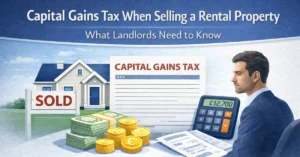
If you sell a buy-to-let property for more than you paid for it, you’ll owe Capital Gains Tax (CGT) on the profit.
How Capital Gains Tax works
CGT is calculated on your taxable gain — which is the profit you make after deducting:
- The original purchase price
- Stamp Duty you paid when you bought it
- Legal fees and estate agent costs when you bought and sold it
- Any capital improvements (like adding an extension or renovating the property)
Capital Gains Tax rates for property (2025/26)
| Tax band | CGT rate on property |
| Basic rate | 18% |
| Higher rate | 24% |
The £3,000 annual CGT allowance
Everyone gets a £3,000 tax-free allowance for Capital Gains each year (down from £6,000 in 2023/24).
This means the first £3,000 of your gain is tax-free. You only pay CGT on anything above that.
Example: Calculating Capital Gains Tax
You bought a property for £200,000 and paid £10,000 in Stamp Duty and legal fees.
You spent £15,000 on a new kitchen and bathroom (capital improvements).
You sell the property for £300,000 and pay £5,000 in estate agent and legal fees.
Sale price: £300,000
Minus purchase costs: £200,000 + £10,000 + £15,000 + £5,000 = £230,000
= Capital gain: £70,000
Minus CGT allowance: £3,000
= Taxable gain: £67,000
If you’re a basic rate taxpayer, you pay 18% CGT = £12,060.
If you’re a higher rate taxpayer, you pay 24% CGT = £16,080.
The 60-day reporting rule
You must report the sale to HMRC and pay any CGT owed within 60 days of completion.
If you miss this deadline, HMRC can charge penalties and interest.
Can you reduce Capital Gains Tax?
Yes. Here are a few legitimate ways:
- Private Residence Relief (PRR): If you lived in the property before renting it out, you may qualify for partial relief
- Offset losses: If you’ve made a loss on another property, you can offset it against this gain
- Spread the sale: If you sell multiple properties in one tax year, consider spreading the sales across tax years to use your annual allowance each time
- Transfer to a spouse: If your spouse is in a lower tax band, transferring the property to them before selling can reduce the overall CGT bill
Do Landlords Pay National Insurance on Rental Income?
No.
Rental income is not subject to National Insurance — only Income Tax.
This applies whether you’re a basic rate, higher rate, or additional rate taxpayer.
There were rumours in 2025 that the Government might introduce an 8% National Insurance levy on rental income, but this was not implemented.
How to Report Your Rental Income to HMRC
If your gross rental income is over £2,500 (or over £1,000 if you want to claim expenses), you need to file a Self Assessment tax return.
Step 1: Register for Self Assessment
If you’ve never filed a tax return before, you need to register with HMRC. You can do this online at GOV.UK.
You’ll get a Unique Taxpayer Reference (UTR) in the post within about 10 days.
Step 2: Complete the UK Property section
When you fill out your Self Assessment, you’ll complete the UK Property pages. This is where you declare:
- Your total rental income
- Your total allowable expenses
- Your mortgage interest payments (for the 20% tax credit)
- Any losses you’re carrying forward
Step 3: File by 31 January
The deadline to file your tax return online is 31 January after the end of the tax year.
For example, for the 2025/26 tax year (6 April 2025 to 5 April 2026), the deadline to file is 31 January 2027.
Step 4: Pay any tax owed
Any tax you owe is also due by 31 January. If you owe more than £1,000, HMRC may also ask for payments on account — advance payments towards next year’s tax bill, paid in July and January.
Making Tax Digital (MTD): What Landlords Need to Know
From April 2026, some landlords will be required to use Making Tax Digital (MTD) to report their rental income.
Who does MTD apply to?
MTD will apply to landlords whose gross rental income (or combined self-employment and rental income) is over £50,000 per year.
From April 2027, this threshold drops to £30,000.
What does MTD mean in practice?
Instead of filing one annual Self Assessment, you’ll need to:
- Keep digital records of your rental income and expenses (using MTD-compatible software)
- Submit quarterly updates to HMRC
- File an annual summary at the end of the tax year
This is a significant change, and it’s worth preparing for it now — especially if you’re close to the £50,000 threshold.
Should You Use a Limited Company for Buy-to-Let?
Some landlords set up a limited company to own their rental properties instead of owning them personally.
The main advantage: you can still deduct mortgage interest in full when calculating Corporation Tax.
How it works
If your property is owned by a limited company:
- The company pays Corporation Tax on rental profits (19% for most companies in 2025/26)
- Mortgage interest is fully deductible as a business expense
- You don’t pay Income Tax on rental income — the company does
Is it worth it?
It depends on your situation. Transferring property into a limited company can trigger Stamp Duty and Capital Gains Tax, so it’s not always straightforward.
Limited companies work best for:
- Higher rate taxpayers (40% or 45%)
- Landlords with large mortgages
- People building a long-term property portfolio
If you’re considering this, speak to an accountant who specialises in property tax.
Common Mistakes Landlords Make With Tax
1. Not registering for Self Assessment on time
If you start renting out a property and don’t register for Self Assessment by the deadline, HMRC can fine you — even if you don’t owe any tax.
2. Claiming capital improvements as expenses
Adding an extension, renovating a kitchen, or converting a loft are capital expenses, not allowable expenses. You can’t deduct them from rental income (though they may reduce Capital Gains Tax when you sell).
3. Forgetting to declare rental income because it’s “under the Personal Allowance”
Even if your total income is below £12,570, if your rental income is over £1,000, you still need to declare it.
4. Not claiming mortgage interest relief
Mortgage interest isn’t deducted automatically — you have to declare it on your tax return to get the 20% tax credit.
5. Missing the 60-day CGT deadline
If you sell a property and don’t report it within 60 days, you’ll face penalties — even if you don’t owe any tax.
Final Thoughts
Buy-to-let tax obligations in the UK are more complex than they used to be — but they’re manageable if you understand the rules.
Here’s the short version:
- You pay Stamp Duty when you buy (5% surcharge on the full price)
- You pay Income Tax on your rental profit every year (and rates are increasing from 2027)
- Mortgage interest no longer reduces your rental profit, but you get a 20% tax credit instead
- You pay Capital Gains Tax when you sell (if you make a profit)
- You must file a Self Assessment if your rental income exceeds £2,500
If you’re not confident handling this yourself — or if you want to make sure you’re claiming every allowable expense and structuring your investments tax-efficiently — it’s worth getting professional help.
At Applegrow Financial Advisors, we specialise in helping landlords with their tax returns, Self Assessment, and tax planning. We’ll make sure you’re compliant, paying the right amount of tax, and not missing any legitimate deductions.
Get in touch and let us handle your landlord tax obligations.
Need Help With Your Buy-to-Let Tax?
Whether you’re a first-time landlord or managing a property portfolio, we can help you stay compliant, reduce your tax bill, and plan for the future.
Contact us today to find out how we can help.